Sunday, April 15, 2007

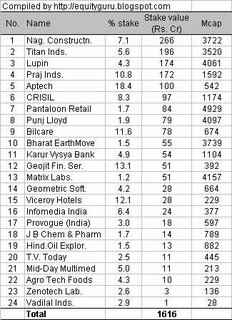
Rakesh Jhunjhunwala buys 2.3% more of Infomedia

RJ has on 13th April, 2007 brought 2.3% or 4.5 lakh shares of Infomedia India Ltd (according to bulk deal data provided by BSE). This brings his total stake in Infomedia to 7.7% (refer Investments of RJ as on 31st Dec’06).

This is an interesting and a classic RJ buy. Let’s see why:

1. Infomedia has remained an underdog compared to most benchmarks, returning far less. Also the company has not been able to scale up in spite of a huge and profitable opportunity.

2. In spite of all the above, Infomedia has certain key strengths, which might have appealed to the investor:

a. Company is a leader in yellow pages business, which provides it with a huge moat around this highly profitable and low capial intensive business.

b. The yellow pages business is highly scalable (company can start such ventures in each and every town of India).

c. Such a business has a tremendous pricing power, once it is established (much higher than a dominant newspaper)

d. The company is also all set to exploit the opportunity presented by the growth in Special Interest Publications (SIP) in India

e. Finance is not a constraint for the company (it had cash of about Rs.50 crore or Rs.25 per share in balance sheet as per March 2006 balance sheet).

f. The majority stake (63%) of Infomedia is held by ICICI Ventures, which itself is primarily an investor

g. Excluding cash, it trades at a multiple of 27x


Thus Infomedia has all the making of a classic RJ buy viz., huge size of opportunity (yellow pages, SIP), scalability (launch of yellow pages in new towns) and a reasonable price (Infomedia is currently in investment mode, hence depressing its short-tem earnings, making P/E based valuation appear deceptively expensive).

Tuesday, April 10, 2007

Warren Buffett announces a 10.9% stake in Burlington Northern Santa Fe Corp (BNSF)

Warren Buffett's Investment vehicle - Berkshire Hathaway - disclosed in a regulatory filing that it held 10.9% stake in Burlington Northern Santa Fe Corp (BNSF), worth about $3.4 billion at current price of $88.08. Burlington Northern Santa Fe Corporation (BNSF), through its subsidiaries, is engaged primarily in the freight rail transportation business. BNSF's key business is to transport a range of products and commodities derived from manufacturing, agricultural and natural resource industries.

BNSF’s subsidiary BNSF Railway Company operates one of the largest North American rail networks, with about 32,000 route miles in 28 states and two Canadian provinces. BNSF Railway Company is among the world’s top transporters of inter-modal traffic, moves more grain than any other American railroad, carries the components of many of the products we depend on daily, and hauls enough low-sulphur coal to generate about ten percent of the electricity produced in the United States.

For 2006, BNSF achieved operating revenues of nearly $15 billion, a 15-percent increase over 2005, which includes double-digit increases in each of the Company’s four business groups. The increase in revenues and an improvement in the Company’s operating ratio enabled BNSF to reach $3.5 billion in operating income, an increase of 20 percent over 2005. As a result, BNSF achieved $5.10 earnings per diluted share for 2006 compared with $4.01 for 2005.

Conclusion:
The buy doesn’t appear to be a classic Buffett pick, as the stock of BNSF is already near its all-time high and does not appear to be a contra bet. However it does have an economic moat in the form of an infrastructure which is difficult to replicate and is much more costly that its book value (Book value of Property, Plant and Equipment in BNSF books was at $27.6 bn, which is at historical asset, current market value of which could be substantially higher). The stock is trading at a trailing twelve months earnings multiple of 17.3x earnings, which appears reasonable for a company which generates a RoE of about 19%. The book value of the stock stands at $28.11 per share, resulting in to a price-book ratio of 3.13x.

Saturday, April 07, 2007

Bill Miller Q4 2006 Commentary: Discussing reasons for the 15 year streak.

Excerpts from Q4 2006 commentary of Bill Miller of Legg Mason Value Trust:

According to Bill Miller (BM) there were two fold reasons for his outperformance:
1. Security Analysis
2. Portfolio Management


Security Analysis:
BM highlights the following key factors related to security analysis:
1. Valuation is inherently uncertain, since it involves the future. However, in spite of this uncertainty, he states that 100% of the value of a stock is determined by its future (though this may be an exaggeration, as large number of asset play stocks have more than 50% of their value derived from their past, i.e., assets creation, which resides in their balance sheet)

2. According to BM, the market discounts whatever information is already available regarding the stock into its price (called as market efficiency). However, there are sometimes, when this ‘discounting’ may be optimistic, while other times it may me pessimistic, giving opportunities to create value for patient investors. BM tries to take advantage of such anomalies in his portfolio. Thus he buys things other people hate, like Kodak, or companies that they think will never conquer their problems, like Sprint. Sometimes it involves owning things people don’t understand properly, such as Amazon, where investors wrongly believe today’s low operating margins are going to be the norm for years.

Portfolio Construction:
1. BM constructs portfolio in a way that is defined in portfolio theories, i.e., on a risk-adjusted rate of return basis.

2. According to BM, a key reason for his streak has been factor diversification, which means he owns a mix of companies whose fundamental valuation factors differ. Thus BM portfolios have high PE and low PE, high price-to-book and low price-to-book. According to him, most investors tend to be relatively undiversified with respect to these valuation factors, with traditional value investors clustered in low valuations, and growth investors in high valuations.

3. According to BM, although funds are subject to requirements regarding diversification by industry or company, they do not have to be diversified by factor, that is, by PE ratios, or price-to-book, or price-to-cash flow. And it has been seen that they mostly are not: value funds tend to have almost all their money in low PE, low price-to-book or cash flow, and growth funds have the opposite. Thus, sometimes growth funds beat value funds and the market, as from 1995 through 1999, and sometimes value funds beat growth funds, as from 2000 through 2006, whereas BM funds which are factor diversified tend to do well in both markets.

Warren Buffet 2006 Common Stocks Portfolio Analysis

  1. The real growth in the value of common stocks (excluding purchases and sales during the year) was 17%.
  2. Growth in market value of new scripts purchased during 2006 was at 35%
  3. The market value of the total common stock portfolio increased to US $61.5 bn, an increase of 32% over previous year, while the cost increased by 44% to US $23 bn.
  4. Allocation to stocks present as on Dec’05 increased 5.3% (cost of those stocks increased from $10.8 bn to $11.4 bn. The market value of such stocks (including fresh purchases increased by 18.7% to $45.4 bn. These ‘old’ stocks formed about 74% of the total market value of the portfolio.
  5. The largest old position in terms of portfolio weight was The Coca Cola Company, followed by American Express Company.
  6. Among the stocks finding their entry in to the portfolio in Calendar year 2006, the highest gain was recorded by POSCO at 102%, and the lowest by Johnson & Johnson at 13%.

Latest ddition to stocks in Buffett's (Berkshire) Portfolio in 2006:

Figures in $ mn

No.

Name

Cost

Mkt Value

% weight

% chg

1

Conoco Phillips .

1066

1,291

17%

21%

2

Johnson & Johnson

1250

1,409

18%

13%

3

POSCO

572

1,158

15%

102%

4

Tesco .

1340

1,820

24%

36%

5

US Bancorp .

969

1,123

15%

16%

6

USG Corp

536

936

12%

75%

Total 'New' Common Stocks

5733

7737

100%

35%

Sunday, March 04, 2007

Warren Buffett Letter to Shareholders 2006 - Highlights

1. Geico has continued to improve its profit margins by increasing its productivity by 47% over a 3 year period. At the same time the company has increased its advertising expenses substantially from $238 mn in 2003 to $631 mn in 2006.

2. Buffett measures the growth in intrinsic value of Berkshire by two yardsticks:
o The first is the amount of investments (including cash and cash-equivalents) that Berkshire owns on a per-share basis and
o The second yardstick is the pre-tax earnings from non-insurance businesses.

3. Berkshire has concluded 2 key acquisitions in 2006:
o ISCAR – a manufacturer of small, consumable cutting tools that are used in conjunction with large and expensive machine tools, and
o TTI – a distributor of electronic components.

4. One of the key highlights was the explanation of the economics of the media industry in general and newspapers in particular. Key points are:
o The fundamentals are definitely eroding for the US Newspaper industry in favor of the cable & satellite broadcasting and the internet. This has caused the profitability of Berkshire’s newspaper operating business, viz, Buffalo News to fall.
o The profitability of the media (newspaper, of news channel, or the internet website) business is dependent on its relative reach. If the relative reach is high, the media can charge a higher charge for advertisements, which can be raised annually to keep increasing the profitability.
o One of the best business to own is a media business with a very high relative market share, which is like a uncontrolled monopoly with a huge pricing power.

5. Buffett expects his key investee companies to grow their earnings by 6% to 8% annually, a rate that would double their earnings every ten years or so.

6. Berkshire has, since 2002, made a profit of $2.2 billion from its bet on depreciation of US dollar.

7. According to Buffett, the slide in dollar is imminent due to the rise in US trade deficit, which has increased to an alarming 6% of GDP. This 6% of GDP is financed by capital account (foreigners buying into US dollar denominated assets). However, one of the most alarming trend is the investment income of US turning negative for the first time since 1915. According to Buffett, the US shall henceforth experience “reverse compounding”, i.e., pay net interest to foreigners on their investments in the USA.

8. Buffett has put out a disguised advertisement for a young fund manager who he wants to appoint to manage the portfolio of Berkshire. The key characteristics of the desired candidate are:
o He should have an impressive investment record
o He should be genetically programmed to recognize and avoid serious risks, including those never before encountered
o He should have independent thinking, emotional stability, and a keen understanding of both human and institutional behavior
o He should remain with Berkshire and not be lured away by money (having Berkshire on a resume would materially enhance the marketability of an investment manager)

9. Buffett has once again stressed the need for compensation to be tied to the operating performance of the manger and nothing else (like competitive payscales)

10. Buffett ridiculed market efficiency by giving the example of Walter Shloss, who has consistently beaten the markets by buying “Cheap Stocks”.

Saturday, February 10, 2007

Rakesh Jhunjhunwala Portfolio - December 2006


No. Name % stake
1 Aptech 18.4
2 Agro Tech Foods 4.3
3 Alphageo (India) 1.6
4 Bharat EarthMove 1.5
5 Bhushan Steel 2.4
6 Bilcare 11.6
7 CRISIL 8.1
8 Geojit Fin. Ser. 13.1
9 Geometric Soft. 2.9
10 Hind.Oil Exploration 3.9
11 Infomedia India 5.4
12 Karur Vysya Bank 4.8
13 Lupin 3.6
14 Mid-Day Multimed 5.0
15 Nag. Constructn. 6.7
16 Panama Petrochem 1.2
17 Pantaloon Retail 1.7
18 Praj Inds. 10.4
19 Prime Focus 6.9
20 Punj Lloyd 1.9
21 Ramco Systems 1.0
22 Titan 6.7
23 Vadilal Inds. 2.9
24 Viceroy Hotels 12.1
25 Zenotech Lab. 3.1
Source: Bseindia.com

Wednesday, January 31, 2007

Bill Miller's Legg Mason Value Trust Portfolio - December 2006


No.

Name

% of Net Assets

1

Tyco International Ltd.

5.2

2

The AES Corp.

5.2

3

Sprint Nextel Corp.

5.0

4

UnitedHealth Group Inc.

4.7

5

Amazon.Com Inc.

4.5

6

J.P. Morgan Chase and Co.

4.4

7

Google Inc.

4.4

8

Qwest Communications International Inc.

4.2

9

Sears Holdings Corp.

4.0

10

Countrywide Financial Corp.

3.5

11

Aetna Inc.

3.4

12

The DIRECTV Group Inc.

3.2

13

Yahoo! Inc.

3.1

14

IAC/InterActiveCorp

3.0

15

Citigroup Inc.

2.8

16

Eastman Kodak Co.

2.6

17

eBay Inc.

2.6

18

Time Warner Inc.

2.5

19

The Home Depot Inc.

2.3

20

American International Group Inc.

2.3

21

Health Net Inc.

2.3

22

Expedia Inc.

1.9

23

Pulte Homes Inc.

1.7

24

Hewlett-Packard Co.

1.7

25

Centex Corp.

1.6

26

Capital One Financial Corp.

1.6

27

Pfizer Inc.

1.6

28

Cisco Systems Inc.

1.6

29

Dell Inc.

1.6

30

Seagate Technology

1.6

31

Electronic Arts Inc. (EA)

1.6

32

General Electric Co.

1.4

33

International Business Machines Corp.

1.4

34

KB HOME

1.0

35

WPP Group PLC

1.0

36

CA Inc.

1.0

37

NIKE Inc.

0.9

38

Masco Corp.

0.6

39

Waste Management Inc.

0.4

40

Symantec Corp.

0.3

41

General Motors Corp.

0.1

Source: Legg Mason


Thursday, November 09, 2006

Update -Rakesh Jhunjhunwala Portfolio - September 2006

As promised earlier, I am updating the list of portfolio stocks held by RJ as at end of September 2006. (you can access the previous post containing the portfolio here)

Lupin (4.09% stake, value of stake = Rs.164 crore)
Provogue (2.96% stake, value of stake = Rs.19 crore)
Alphageo (1.56% stake, value of stake = Rs.1 crore)

Total Portfolio value = Rs.1873 crore (up 16% over June 2006 quarter)


Note: The ace investor has added the following two new stocks in his portfolio in September 2006 quarter:
.Alphageo – for research click here.
.Panama Petrochem – for research click here

Saturday, November 04, 2006

Rakesh Jhunjhunwala Portfolio - September 2006


The above portfolio of RJ is as declared to stock exchanges as on Oct 31, 2006. I shall update the same as and when more information is filed with the exchanges.

Note: Panama Petrochem Ltd is the new stock addition to the master investor’s portfolio in September 2006 quarter. I shall shortly post more research on Panama Petrochem on this blog.

Rakesh Jhunjhunwala Portfolio - June'2006

The above portfolio of RJ is as declared to stock exchanges as at June 30, 2006

Monday, August 07, 2006

Warren E Buffett – A Profile

Warren Edward Buffett is an American investor, businessman and philanthropist and is the largest shareholder and CEO of his investment vehicle, Berkshire Hathaway. He is ranked by Forbes as the second-richest person in the world, behind the Microsoft co-founder Bill Gates.
As on February 2007, the value of his stake in Berkshire Hathaway was valued upwards of $50 bn.
In June 2006, he made a commitment to give away his fortune to charity, with 85% of it going to the Bill and Melinda Gates Foundation.
Investment Philosophy:
Buffett’s investment philosophy had the following key tenants:
· Invest in companies with a large economic moat (high degree of competitive advantage) which is reflected in its ability to raise prices of its products over a period of time.
· Invest with in your circle of competence (invest in companies and businesses you understand)
· Invest only for the long term. Buffet immortalized long-term investing by following quote – “my favorite holding period is forever”.
· Invest in businesses with a consistent and high absolute return on capital employed, which should be reflected in a market price to book value of greater than one (a company should generate more than $1 for every dollar invested in business)
· Invest a price which provides a very high margin of safety (purchase your investment a huge discount to its intrinsic value)
· Intrinsic value of a business is equal to the present value of all the future cash that can be taken out of that business
· Focus on Owner Earnings (free cash flow) in valuing a business.

Sunday, July 09, 2006

Bill Miller – A Profile

Bill Miller is currently the Chairman & Chief Investment Officer at Legg Mason Capital Management, Baltimore, USA. Bill Miller joined Legg Mason in 1981 and manages the Value Trust and Opportunity Trust mutual funds. He was Legg Mason's Director of Research from October 1981 through June 1985 and assumed overall responsibility for the equity funds management area of Legg Mason in late 1990. Prior to joining Legg Mason, he served as Treasurer of the J.E. Baker Co. Bill graduated, with honors, from Washington and Lee University

in 1972 with a degree in Economics. He is on the Board of Trustees at the Santa Fe Institute, a leading center for multidisciplinary research in complex systems theory. Bill received his CFA designation in 1986.

He is a portfolio manager of the Legg Mason Value Trust mutual fund, the after-fee return of which has beaten the S&P 500 index for 15 consecutive years from 1991 to 2006.

Investment Approach:

Bill has often being criticized that he is a growth investor in the garb of a value seeker, as his portfolio is dominated by so called growth stocks like Amazon, Nextlel, etc. However, as he correctly puts it, he is literally a “Value Investor”, a long term patient investor (and not trader as can be seen from his low portfolio turnover) who seeks value (which he defines as a deep discount to his assessment of intrinsic value). According to Mr.Miller, intrinsic value is not judged simply by the book value or earnings per share (EPS), but by free cash flow generation, return on capital employed and long term sustainable high RoCE growth. This value changes with passage of time and hence the models of value also need to be changed peiodically, which can make a stock which was expensive two years back at the same price, a value buy today. Thus, the heart of Mr.Miller’s investment philosophy is the judgment of intrinsic value and then buying the business at a deep discount to such value.

Friday, June 09, 2006

Rakesh Jhunjhunwala - A Profile

Mr Rakesh Jhunjhunwala is a well known and astute Indian investor and trader. He is both a Value investor as well as a trader. Those hard core value investing fans might be wondering how can a single individual be both an investor as well as a trader (since both require completely opposite mental make-up)! Mr. Jhunjhunwala is known for his knack for picking undervalued stocks and sitting on them patiently for years to yield supernormal returns. His most famous quote is "I have made most money not by being right but by sitting tight".

Summary of Investment Philosophy:

According to Mr.Jhunjhunwala, key aspects to consider in an equity investment are:
. Size of the external opportunity
. Sustainability of competitive ability
. Scalability and operating leverage
. Management quality and capital efficiency
. Price and value divergence
Out of the above 5 factors, the last one, i.e., price what you pay is the most important, and if this condition is not satisfied, Mr. Jhunjhunwala will never invest in a stock.He also places great emphasis on superior business models rather than sectors for his investment decisions.

Thursday, May 04, 2006

Introduction

The author intends to discuss his personal views and opinions on the masters (or gurus) of investment world. The blog shall also publish articles, news, portfolios of featured investment managers/ investors. The objective is to share views with like minded long term investors/analysts/readers that follow or intend to follow the philosophies of such stock market masters.

Author invites comments /opinions/articles from like-minded investors/analysts/readers on the opinions discussed in the blog. If you have any interesting article/news, please feel free to post a comment for the same on the blog or email me at indian.analyst@gmail.com

Disclaimer:
The views and articles discussed in this blog are strictly for educational purpose only. The investments discussed in this blog may not be suitable for all investors. Investors must make their own investment decisions based on their specific investment objectives and financial position and using such independent advisors as they believe necessary. The author may have positions in stocks at the time of its discussion on the blog. Users are advised to peruse the articles and other data in the blog only for their information. This blog does not have any affiliation, expressed or implied with the organisation where the author is working.

Technorati Profile